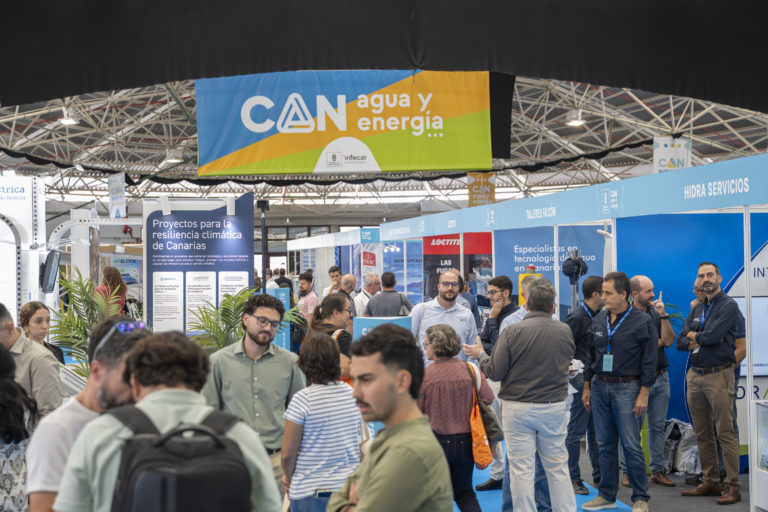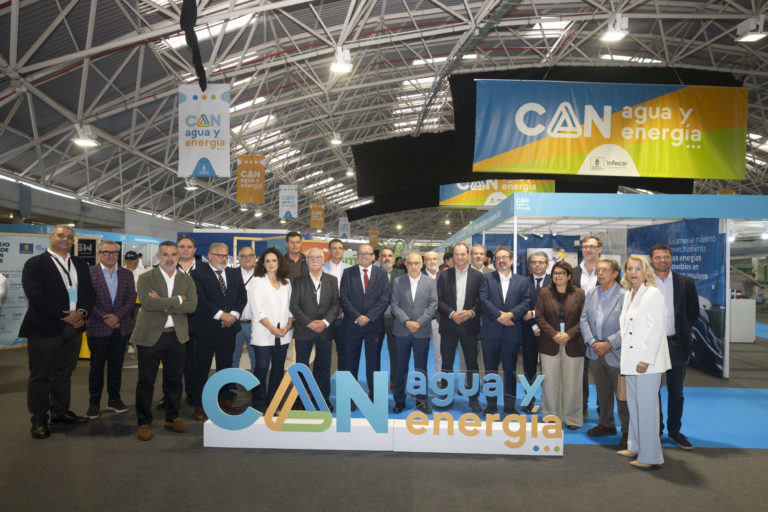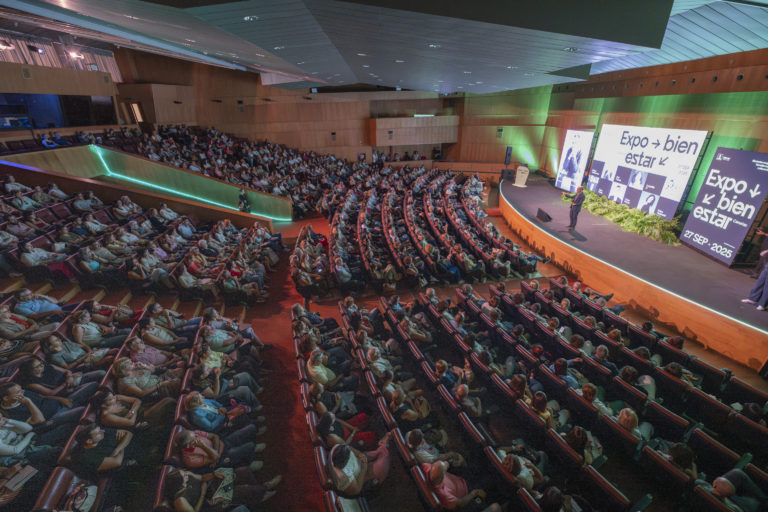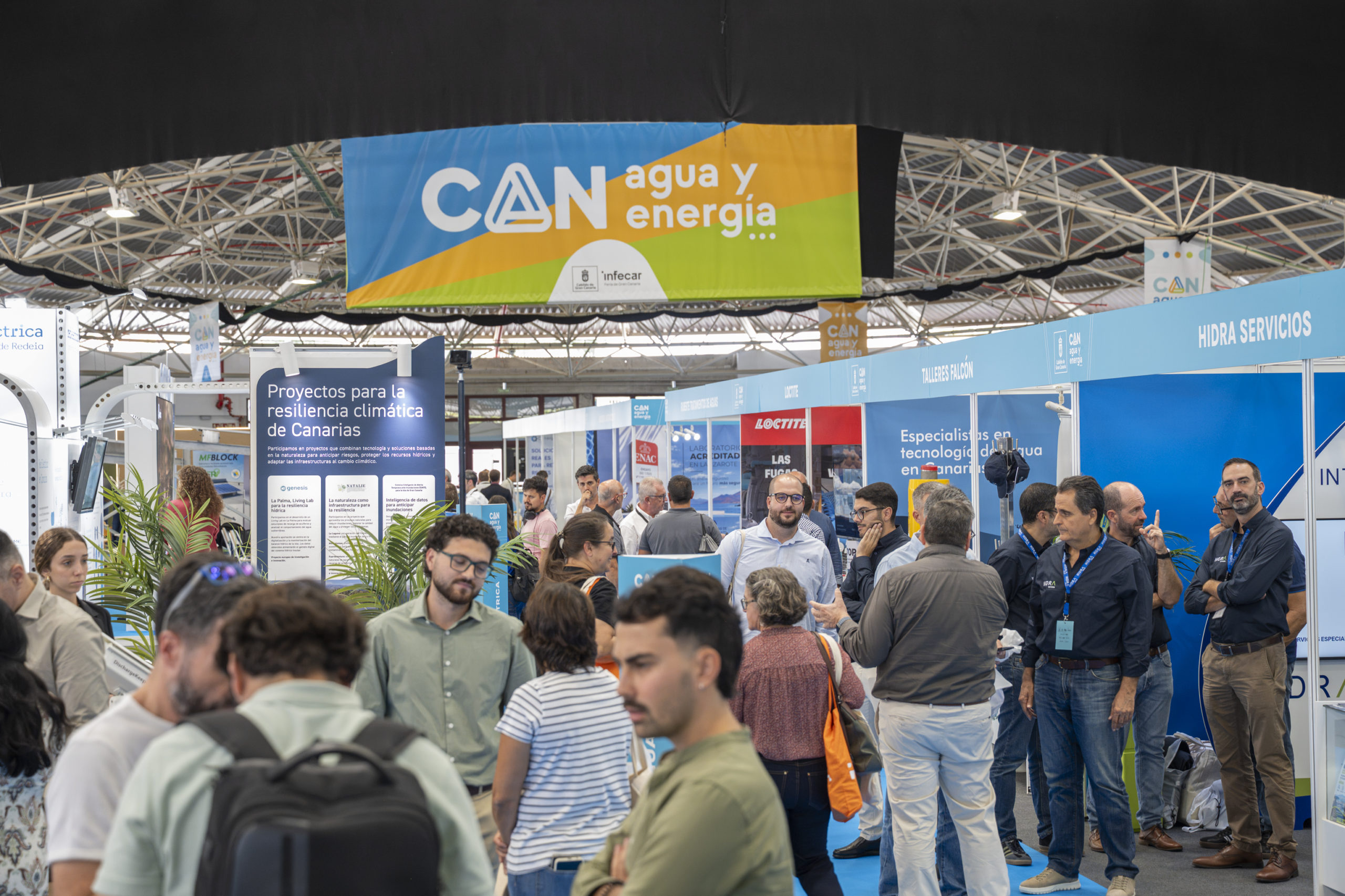
- Professionals and businesses explored issues related to the energy transition, water management and clean, efficient energy throughout the fair
- The event hosted the Canagua y Energía 2026 Awards, recognising outstanding careers and initiatives in sustainability, innovation and the efficient use of resources
The 15th edition of Canagua y Energía has drawn to a close, reaffirming its relevance as a professional meeting place for discovering the latest solutions for the energy transition. According to Antonio Morales, President of the Cabildo de Gran Canaria, this latest edition “puts Gran Canaria where it belongs: as a territory that has turned its vulnerability into knowledge, and that knowledge into an opportunity for the Canary Islands, Europe and neighbouring countries facing the same challenges”.
For two days, the Agüimes Exhibition Centre became “a showcase for solutions, but above all a place for dialogue, sharing experiences and building partnerships”. More than 60 companies presented their products and services across the extensive exhibition area, around 20 initiatives showcased innovative proposals in short, 15-minute presentations at the Speaker’s Corner, and a broad line-up of expert speakers discussed the latest developments in the sector. Through its presentations, talks and panel discussions, alongside B2B meetings involving more than 100 participants, the fair once again reinforced its position as a leading meeting place for the energy sector in the Canary Islands.
The event explored the latest trends and challenges facing businesses and institutions in clean, efficient energy. Particular attention was given to the evolving energy model in the Canary Islands, energy storage, cybersecurity, water reuse and operational risks in water management across the archipelago, as well as the wider integration of renewable energy in island territories.
Blanca García, from SMA, opened the conference programme on the second day of Canagua y Energía by highlighting the “major benefits” of solar photovoltaics. She also stressed that integrating renewables remains a challenge for the Canary Islands: “They are essential, and we need to integrate them carefully, particularly in territories such as the Canary Islands”, where “energy independence is even more necessary”.
Andrés Franco, CEO of Isigenere, highlighted the potential of floating solar photovoltaics for the islands. This technology can increase panel output by 10–15%, reduce evaporation and algae growth, and generate electricity without taking up agricultural land. He also explained that it is adaptable and straightforward to install—“you use practically the same tools as you would to assemble IKEA furniture”—although each project requires an assessment of logistics, anchoring, maintenance, and resistance to wind and waves.
The cybersecurity session began with Álvaro de Lossada, Head of the Cybersecurity Coordination Office, who examined the implications of the NIS2 Directive for the water sector and the types of risks it faces. The new directive broadens cybersecurity requirements across the EU and extends their scope to more organisations. He explained that “medium-sized and large companies will now fall under the new regulations; this will be a challenge for everyone, as they are not used to having to implement cybersecurity policies”. He added: “The directive will make things more complex, but it is absolutely necessary, and failure to comply will also have consequences.”
Carmelo Mena, from the Water Department at the Canary Islands Institute of Technology (ITC), and Juan Antonio León Robaina, Head of the Infrastructure Service at the Directorate-General for Water of the Government of the Canary Islands, then assessed the situation across the islands. Juan Antonio León highlighted the particular vulnerability of water infrastructure in the archipelago, explaining that “in the Canary Islands, water is manufactured” and that water systems on the different islands are not interconnected. This increases the potential impact of an attack or power failure: “If the electricity system has a problem, so does the water system.” Carmelo Mena warned of the problems that artificial intelligence can pose, as some control systems still rely on “old technology facing a modern reality”, making stronger protection and greater awareness across the sector essential.
The subsequent panel discussion, moderated by Carmelo Santana, Managing Director of the Gran Canaria Island Water Council, also brought together Pablo González Martín, Carlos Guerrero, Juan Vicente Abreu Ravelo and Renzo Lovón Paz. The discussion focused on the need to approach cybersecurity through the real operational risks that an attack on water infrastructure could create. Participants stressed the importance of explaining these risks—and the consequences of inaction—to policymakers and senior managers, so that investment in protection is understood as essential to the safety and operation of these systems. They also highlighted the need to maintain protective measures continuously and promote shared responsibility among public authorities, operators, concession holders and partner companies.
The afternoon session focused on water reuse and adaptation to Royal Decree 1085/2024. Belén Gutiérrez, President of AEDYR, and Antonio Casañas González, a member of its governing board, discussed water reuse. Juan Antonio León Robaina then explained the implementation of reclaimed water risk management plans in Gran Canaria. The programme concluded with a panel discussion on water reuse, moderated by Baltasar Peñate Suárez, Head of the Water Department at the Canary Islands Institute of Technology (ITC).
Canagua y Energía 2026 Awards
The fair concluded with the Canagua y Energía 2026 Awards, promoted by the Gran Canaria Island Energy Council and the Gran Canaria Island Water Council. Individuals and initiatives making outstanding contributions to innovation, conservation and the efficient use of resources in the Canary Islands received awards that once again celebrated careers and projects advancing sustainability across the islands. As the President stated during the ceremony, “the development of Gran Canaria is built on the commitment, knowledge and dedication of those who work every day to manage our natural resources better”.
In the Sustainability and Energy category, the award for a social and collective initiative went to the Salto a la Transición Ecológica project, while FSM Energías received the business initiative award. Rafael Martell Sánchez was also honoured, alongside academic work by Yraya Duque Tovar and Javier Alfredo Esteban Segura. In the Sustainability and Water category, the award for a social and collective initiative went to CIFP Felo Monzón Grau-Bassas, while Transvirgin, S.L. received the business initiative award. Baltasar Peñate Suárez was honoured for his outstanding professional career, and academic work by Amanda Hernández Montesdeoca and Gara del Señor Carreño Hernández was also recognised.
A highlight of the ceremony was the presentation of two special commendations awarded by the Cabildo this year. Ainara Irigoyen Zarragoicoechea was recognised for her technical contribution and ability to foster cooperation between institutions on projects connecting water and energy. José Rafael “Felo” Sánchez Ramírez, a key figure in the relationship between energy and water, was honoured for his role in developing an integrated approach to their management.
The President congratulated the recipients, explaining that the awards “recognise the efforts of professionals, businesses, educational institutions and researchers who share the same conviction: that progress on our island depends on our ability to innovate, educate, research and manage its resources responsibly”.
Canagua y Energía is promoted by the Cabildo de Gran Canaria through the Gran Canaria Island Energy Council and the Gran Canaria Island Water Council, and organised by Infecar, Feria de Gran Canaria. This edition was supported by Cajasiete as an official partner, with additional support from Agüimes Town Council. Canaragua and Green Efficient supported the fair as platinum sponsors of the water and energy programmes, respectively; Aqualia and LONGi Solar were gold sponsors of the Speaker’s Corner and B2B area, respectively; and Redstack was a silver sponsor.