- A sea rescue helicopter display and a major nautical parade bring a well-attended International Sea Fair to a close
- The fair welcomed more than 14,000 visitors over its three days, following a Sunday at Sanapú that unfolded as a lively family celebration
- A sea rescue helicopter display by SAR (Air Search and Rescue) and a major nautical parade in the waters of the Port of Las Palmas were two of the main attractions drawing the attention of the large crowds visiting the International Sea Fair on its final day, Sunday 24 May.
- Fimar 2026 closed its 15th edition firmly established as a powerful platform connecting businesses linked to the blue economy and researchers studying marine life and the oceans with the wider public
Fimar was held around Muelle Sanapú, in Las Palmas de Gran Canaria, from Friday 22 May through to Sunday 24 May. It is promoted by the Cabildo de Gran Canaria, Las Palmas de Gran Canaria City Council and Puertos de Las Palmas, and organised by Infecar, Feria de Gran Canaria, together with the Department of Ciudad de Mar of the city council.
Blue economy, career opportunities and outreach
A total of 61 exhibitors took part in the fair, including companies from the nautical, marine and maritime sectors, as well as fashion, insurance, 3D printing, tourism products and other sea-related activities. Public institutions, sports clubs, civic organisations such as the Maritime Collectors Association, and several faculties and bodies from the University of Las Palmas de Gran Canaria were also represented.
Around thirty experts and young researchers, the vast majority from the ULPGC, spent three days delivering talks open to the public on marine life in Canary Islands waters, the evolution of the oceans, predicting ocean behaviour through AI, the growing presence of toxins produced by algae in the archipelago, and the effect of calima as a trigger for an explosion of life in the islands’ marine ecosystem.
Strong attendance and local interest
Large numbers of people attended the Fimar venue throughout the fair, which in recent years has consolidated its ability to attract around 14,000 visitors, a figure close to that recorded in this year’s edition. Nautical companies were able to close or agree sales ranging from medium and small boats to fashion accessories such as hats, bracelets and clothing.
In general, the commercial offer drew the strongest interest from local visitors, confirming the continued interest among the public and among small and medium-sized businesses across the islands in the blue economy sector.
In addition, Fimar registered more than thirty applications for the compulsory boat skipper course. Countless introductory sailing experiences also took place on the water, which also hosted displays and demonstrations of sailing and traditional Canarian lateen sailing, among other disciplines. These activities once again provided some of the fair’s most memorable images.
The success of the boat visits
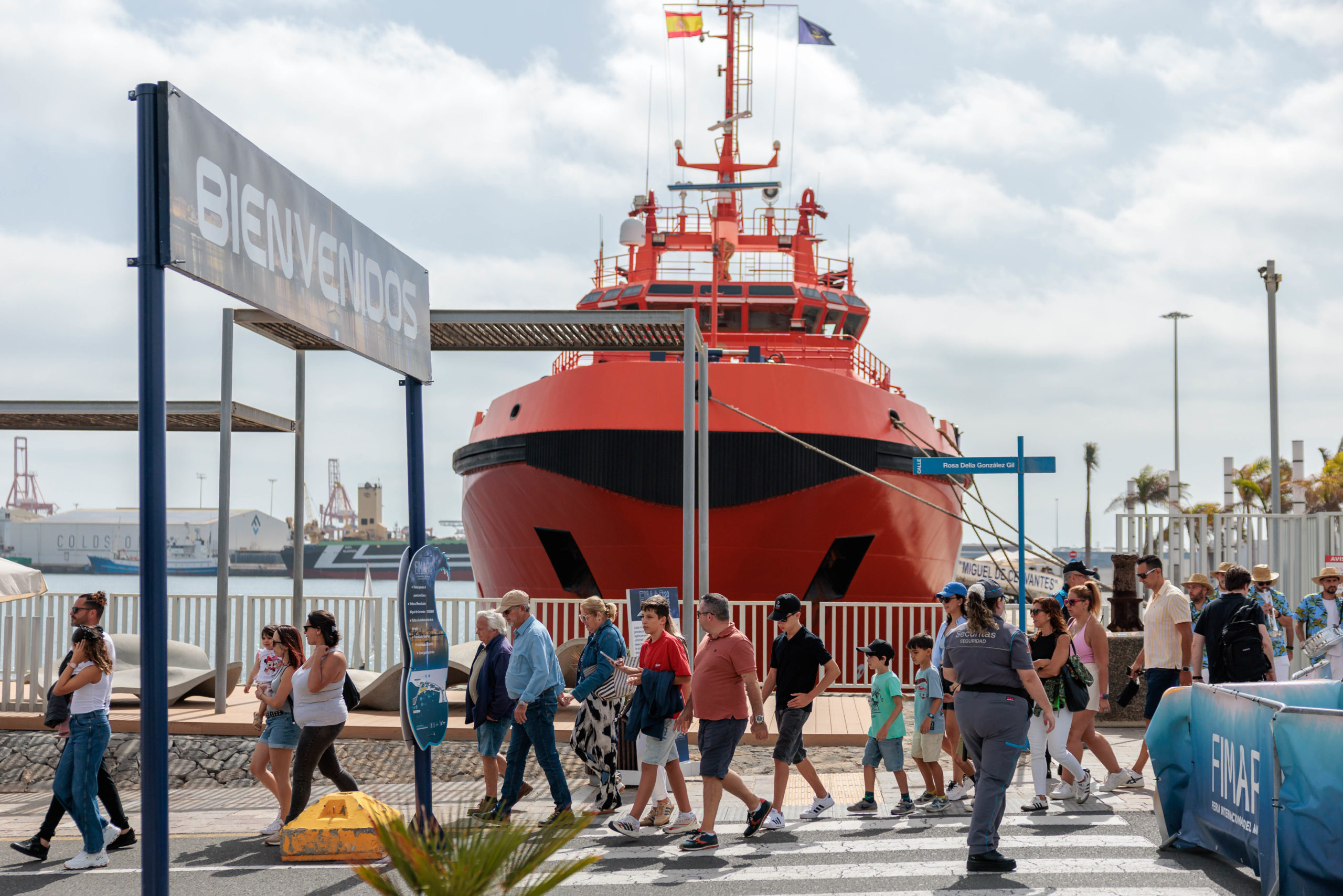
One of the great attractions visitors have traditionally found at the International Sea Fair is the chance to enjoy boat trips around the interior of the harbour. In total, around 1,200 people took part in these highly popular trips throughout the event.
More than one hundred people boarded the City Sightseeing vessel, operated by the same company that runs the city’s tourist bus service, across a dozen scheduled trips during the fair.
Vessels from the Navy and Salvamento Marítimo (SASEMAR) also attracted large numbers of visitors interested in seeing the inside of these ships and learning first-hand how they operate.
Music, food and families
Sunday 24 May had a particularly festive feel at Fimar, with live music throughout the morning provided by Family Soul Band, performing classic favourites from the genre.
The stage, located at the entrance to the food area and the access to the children’s zone, became the prelude to other highly active areas of the event. Food trucks saw strong demand on the hottest day of this year’s edition of FIMAR, and ice creams were, unsurprisingly, an essential accompaniment.
The children’s area, with games specially designed for ages 0 to 3 and 0 to 6, was also one of the fair’s highlights. Families frequently accompanied younger visitors in educational and playful activities that once again confirmed the strong impact the International Sea Fair has on younger audiences.
The outermost regions and Martinique
All of this marked Fimar’s 15th anniversary in a year when the central theme focused on the Outermost Regions. Martinique was the invited territory in 2026, making this the first year in which the fair welcomed participation from the other side of the Atlantic.
The delegation from the French overseas territory took part on 21 May in a set of preliminary sessions held at the Gran Canaria Marine-Maritime Innovation Centre, located in the Fundación Puertos de Las Palmas building. Experts, public representatives and businesspeople from Martinique and the Canary Islands gathered collaborative framework born from the TWINNED by STARS project led by the TIDES Institute of the University of Las Palmas de Gran Canaria, aimed at developing marine ecotourism and astrotourism in the outermost regions.
This event was organised in collaboration with the Cabildo de Gran Canaria, the Society for Economic Promotion of Gran Canaria (SPEGC), and the Marine-Maritime High Technology Incubator (IAT), also with significant participation from Ciudad de Mar of Las Palmas de Gran Canaria. It took place in the same week that the European Union was holding a meeting with the ports of the outermost regions to assess the current and future regulatory impact on these territories.