- The President of the Cabildo de Gran Canaria, Antonio Morales, highlights at the opening of the International Sea Fair that sea-related sectors already account for 11% of Gran Canaria’s GDP
- The Mayor of Las Palmas de Gran Canaria, Carolina Darias, underlines the important role the fair gives to the dissemination of scientific knowledge about the oceans
- The President of the Port Authority of Las Palmas, Beatriz Calzada, stresses the opportunities that the Port and the maritime sector offer for the professional future of younger audiences
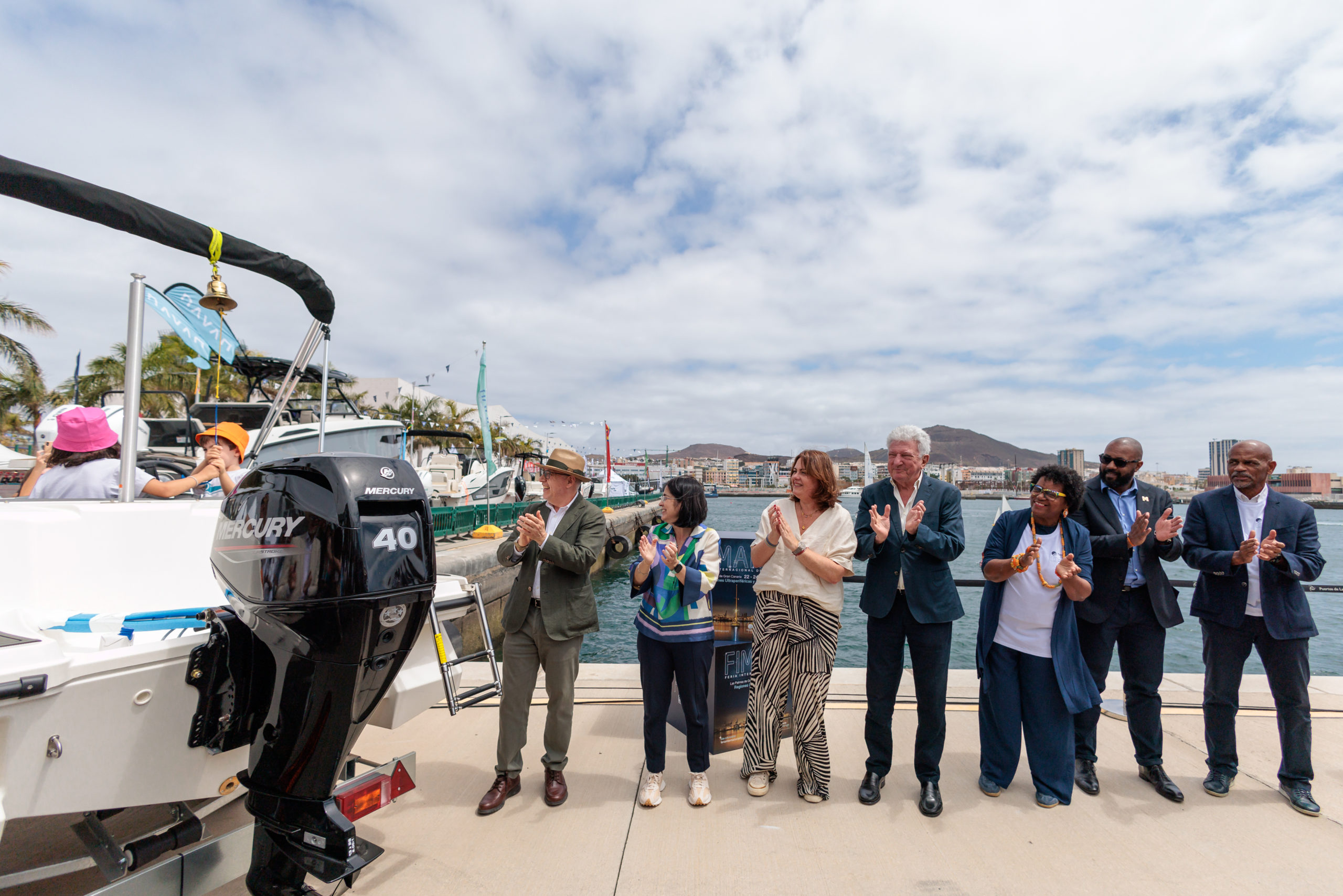
The President of the Cabildo de Gran Canaria, Antonio Morales; the Mayor of Las Palmas de Gran Canaria, Carolina Darias; the President of the Port Authority of Las Palmas, Beatriz Calzada; and the First Deputy Mayor and Councillor for Ciudad de Mar of Las Palmas de Gran Canaria, Pedro Quevedo, officially opened this Friday, 22 May, the 15th edition of the International Sea Fair, Fimar 2026.
The opening ceremony, held at the meeting point between the Wilson and Sanapú quays, served to highlight the growing importance of the blue economy in the island context, the role of scientific outreach within the fair and the professional future opening up in the maritime and port sectors for younger generations.
Fimar, which takes place from 22 to 24 May at Sanapú, is promoted by the Cabildo de Gran Canaria, Las Palmas de Gran Canaria City Council and Puertos de Las Palmas, and organised by Infecar, Feria de Gran Canaria and the Ciudad de Mar Department of the capital city.
“Continuing to blue” the island economy
The President of the Cabildo de Gran Canaria, Antonio Morales, stressed during the opening of the fair, which was also attended by a delegation from Martinique as guest territory, that “the blue economy plays a fundamental role in the island’s economic diversification”. He noted that this sea-related sector “is well above the Canary Islands average”, pointing out that in Gran Canaria the blue economy “accounts for 11% of Gross Domestic Product”, compared with the Archipelago’s average of 4%.
Morales explained that “this means that in recent years an ecosystem linked to the sea has been consolidated, connected to innovation, biotechnology, research, the development of marine sports, port activity, the naval industry linked to the port industry, offshore wind energy and all its development, as well as marine research through organisations such as the Oceanic Platform of the Canary Islands”. He went on to state that “in Gran Canaria, the blue economy currently represents a higher percentage of GDP than industry as a whole”.
In this context, the island President described Fimar as “a showcase for all of this, where we can see all the sectors involved: the port sector, institutions, the University of Las Palmas de Gran Canaria, research centres and civil society”, as well as “small and medium-sized enterprises carrying out important activity around the marine and maritime sector”.
Morales encouraged the island to “continue blueing the economy of Gran Canaria”, because “we believe it is an extraordinary way to contribute to economic diversification in an Atlantic archipelagic territory such as ours”, and to generate, “from port activity itself, endogenous elements of development that do not make us depend on the outside”.
The importance of scientific outreach
The Mayor of Las Palmas de Gran Canaria, Carolina Darias, expressed her enthusiasm for the start of a new edition of an event that is “already consolidated” and held “in a city where Las Palmas de Gran Canaria City Council, through the Ciudad de Mar Department led by Pedro Quevedo, has carried out important work to promote and coordinate this fair”.
Darias recalled that the capital of Gran Canaria “is a city that lives facing the sea” and feels the sea as “a way of life”. The Mayor also highlighted the presence of Martinique as guest territory in this edition, dedicated to the Outermost Regions, describing it as “a reinforcement of our tricontinentality”. She also underlined the opportunity for knowledge exchange created by the presence of the Caribbean delegation, which took part in previous sessions on collaboration in marine ecotourism and astrotourism.
The Mayor stated that “Las Palmas de Gran Canaria City Council wants Fimar to continue growing, hand in hand with all administrations, in order to promote everything related to the blue economy”. She added that “the scientific outreach work carried out at the fair is tremendously interesting and very well judged”.
“Blue economy, yes,” she added, “but also innovation and scientific outreach. Science is what continues to shed light on all the issues that allow us to keep moving forward”. In this regard, Fimar 2026 “has a very important scientific outreach component that the Ciudad de Mar Department has wanted to promote so that citizens can take part”. In particular, the Mayor concluded, “children”, thanks to the special workshops scheduled for families to enjoy “fantastic” days during the fair.
A professional future in the Port
The President of the Port Authority of Las Palmas, Beatriz Calzada, highlighted Fimar’s status as a “fully consolidated fair” in both the city and the Port, stressing that it is an opportunity “for companies, institutions and all the organisations present to show people what we do, how we work and how we are involved in what is known as the blue economy”. In other words, “in projects related to sustainability and the preservation of our biodiversity, while also showing all the opportunities that maritime and port activity offers our people”.
Calzada noted that this year, at the Port Authority’s own stand at Fimar, “we have focused precisely on professions, on showing, above all to younger audiences, the opportunities available for their professional development. So that they can have a future, get to know the Port better and understand the opportunities it can offer them”.
The President of the Port Authority also highlighted that, once again, one of the major attractions of the event will be the boat trips, which allow visitors to “discover our Port in a much more interesting and different way, and see all the activity it generates”, as well as “view the city from the sea”.
Calzada also referred to the presence of Martinique as guest territory. “I think it has been very timely,” she said. She explained that on 18 and 19 May, “all representatives of the ports of Europe’s outermost regions were in Brussels, calling for fairer treatment, more in line with our needs, in everything related to regulation and the adoption of rules in which the reality of our territories is sometimes forgotten”. In this regard, she said, Martinique’s participation in Fimar “has been very useful”.
Programme under way
Following the official opening, Fimar began its 15th edition, with a programme running until Sunday 24 May. The event includes a total of 29 outreach talks delivered by a wide range of experts, mainly from the University of Las Palmas de Gran Canaria, and brings together 61 exhibitors, including companies, institutions and social organisations whose activity is directly connected to the sea.
Marine vehicles, fashion, nautical activities, specialists from the marine and maritime sectors, several faculties of the ULPGC, sports clubs and even the Association of Maritime Collectors are all present at the island’s major blue economy event.
The programme of the fair, which is free to attend, includes the traditional boat trips inside the Port, sea baptisms and water-based demonstrations, children’s activities and visits to the Salvamento Marítimo and Spanish Navy vessels, as well as a sea rescue demonstration with a helicopter.
This is complemented by a full programme of sea baptisms and demonstrations in the Port’s water area, a gastronomic zone and a children’s area with a complete schedule of activities for families to enjoy.
The full Fimar programme, including exhibitors, talks and presentations, is available on the official fair website: https://feriainternacionaldelmar.com/.