- More than 1,500 people attended the fair, which featured 50 exhibiting companies in this first edition.
- Professionals and companies from the sector made the most of this space to build synergies, identify business opportunities and move their projects forward.
The Canary Islands Logistics Innovation Fair (FILCA) came to a successful close today, exceeding expectations, with more than 1,500 visitors attending this first edition at the Agüimes Exhibition Centre. Logistics is “a strategic sector for the island of Gran Canaria and for the Canary Islands as a whole,” stated Minerva Alonso, Regional Councillor for Economic Development, Industry, Trade and Crafts. For this reason, the Cabildo of Gran Canaria will hold a second edition next year, “with the essential cooperation of other institutions and the logistics and innovation business sector of Gran Canaria.”
The councillor recalled that this first edition is the result of cooperation between the private sector, the Agüimes Town Council and the Cabildo of Gran Canaria, through Infecar – Feria de Gran Canaria. With FILCA, the island government opens a new chapter in its event programme at the south-east exhibition venue, which on this occasion hosted 50 exhibiting companies, not only from Gran Canaria but also from Tenerife and several mainland Spanish cities.
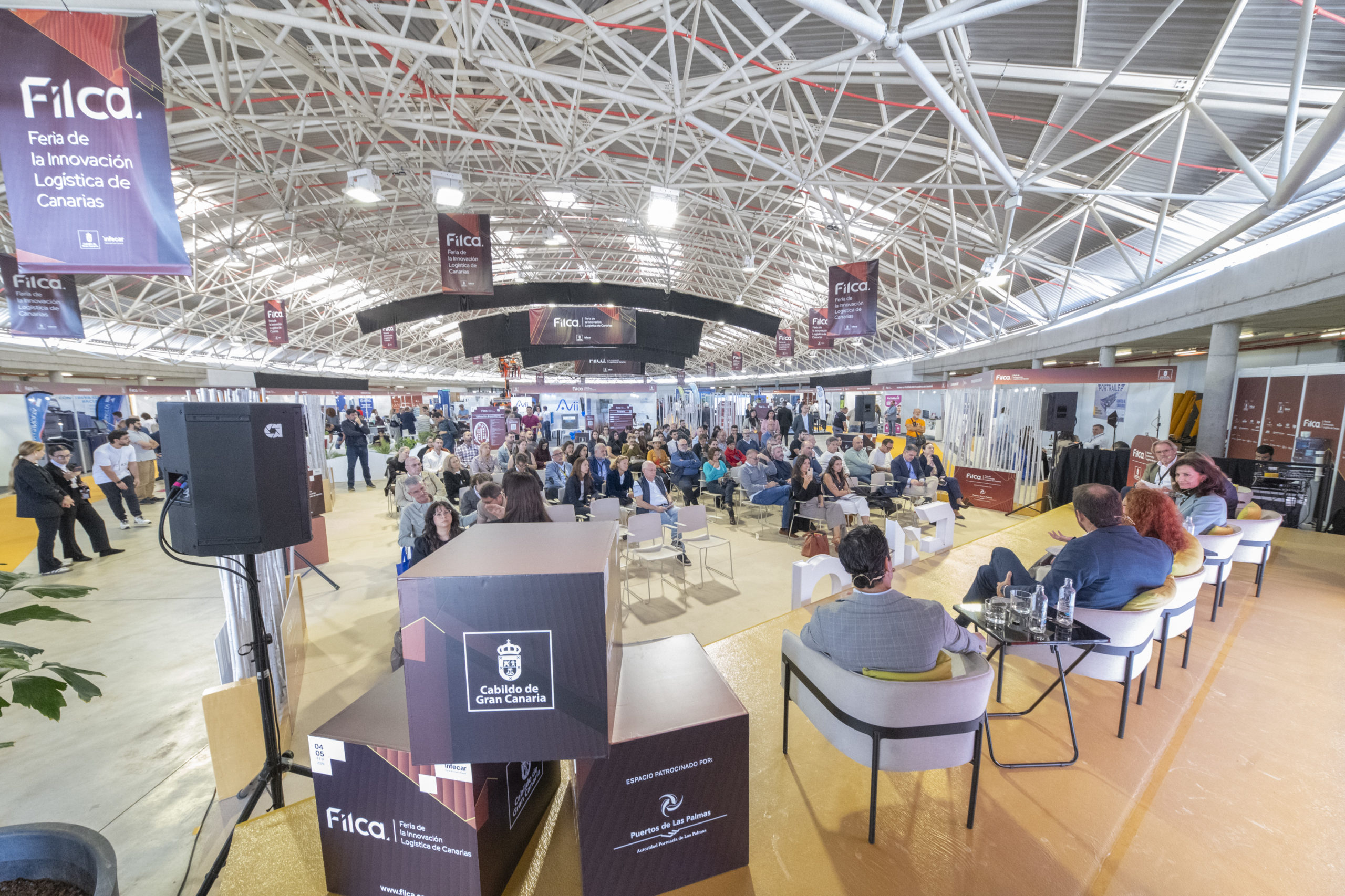
Over the course of two days, attendees were able to discover first-hand a wide range of products and services on offer, while also establishing valuable business contacts. In parallel, a series of talks and roundtable discussions focused on logistics and transport, addressing the sector’s main challenges and future outlook.
Yaiza Canosa, founder of the logistics startup GOI and current CEO of Boudica Canosa, shared her experience in the logistics sector, particularly operating in the Canary Islands, which she described as “an additional challenge for companies.” She compared it to a final degree project “due to its complexity, added costs and the need for thorough planning.” According to Canosa, logistics in the islands often generates “fear and uncertainty, especially because of customs procedures,” which she described as “more of an art than a process.” This lack of predictability, she noted, discourages companies considering shipments to the Canary Islands, highlighting the importance of working with local operators who understand the territory and its processes, thereby strengthening the local economy.
In the roundtable on digitalisation and logistics, speakers agreed that technological investment must be accompanied by strong change management. Marco Antonio Suárez, Head of Procurement and Supply Chain Development at Spar Gran Canaria, pointed out that resistance to change—both organisational and individual—remains one of the main barriers. Similarly, Airam Rodríguez, CEO of Híades Business Patterns, stressed the importance of involving users throughout the entire digital transformation process, a slower approach but one that is key to ensuring success. David Falcón, Head of Data & Revenue at Fred. Olsen Express, emphasised that implementation is impossible without full involvement, while Víctor Socas, Director of IT and Digital Transformation at Grupo CopiCanarias, reminded attendees that digitalisation is a living process requiring continuous adjustments and active participation.
During the roundtable “Ports and Sustainable Logistics in the Canary Islands”, Beatriz Calzada, President of the Las Palmas Port Authority, highlighted the importance of a common European regulatory framework to avoid competitive disadvantages. She also stressed the need to adapt to future challenges by opening new routes, exploring new markets and implementing emerging technologies such as artificial intelligence and digital twins.
Lourdes Trujillo, Director of the Pormar Maritime-Port Chair, warned of the risks posed by the Fit for 55 emissions trading system and its impact on the competitiveness of Canary Islands ports. Other speakers, including Manuel Herrera, President of Ateia-Oltra Las Palmas, and José Mayor, President of Oneport Canarias, agreed on the need to strengthen public–private collaboration, improve operational efficiency and move forward in digitalisation, automation and sustainability across port infrastructures.
At the roundtable “Customs and Taxation Applied to Canary Islands Logistics”, participants highlighted regulatory complexity and territorial singularity as major challenges. María del Carmen Santana, President of the Association of Customs Agents, stressed the importance of correctly classifying goods, while Raquel Peligero, Director of the Canary Islands Tax Agency, advocated for digitalisation to streamline procedures. Laura Dapresa, Secretary General of ASINCA, and Gabriel Corujo, representative of the Ministry of Finance at the Free Trade Zone, agreed on the need to simplify legislation and encourage public–private cooperation and coordination between administrations. Gustavo Vidueira, from ASOCELPA, pointed to the lack of regulatory awareness among SMEs and suggested redesigning the REF (Canary Islands Economic and Fiscal Regime) to better serve the common interest.
The roundtable “Network of Logistics Platforms and Operational Nodes” addressed the shortcomings of logistics and industrial spaces in the Canary Islands and their role within the supply chain. Cornelio Suárez, President of AENAGA, noted that industrial estates have supported intense activity without proportional improvements in infrastructure, calling for greater institutional attention to access, services and planning. María Lourdes Pérez, Vice President of AEGORO, emphasised the need for a more integrated vision to include these areas in broader logistics strategies. The discussion also covered tensions between industrial, port and urban activity—such as in El Sebadal—and highlighted the importance of viewing ports as part of a connected logistics network.
Promoted and funded by the Cabildo of Gran Canaria and organised by Infecar, FILCA is supported by the Agüimes Town Council. It is also a shared initiative involving strategic stakeholders working together to modernise the business fabric, including the Association of Entrepreneurs of the Arinaga Industrial Zone (AENAGA), the Arinaga Business Conservation Entity (ECOAGA) and the Gran Canaria Chamber of Commerce.
In addition, numerous organisations and companies have shown their support through sponsorship, including Puertos de Las Palmas, Fred. Olsen, Grupo Raminatrans (a leader in international transport solutions), ICP Canarias (a benchmark in integrated logistics and distribution), JSV Move to Green (committed to sustainable transport), Grupo CopiCanarias (providing comprehensive IT solutions for digital transformation), and Tonik24 Trading, which offers logistics brokerage services between Germany and the Canary Islands through its innovative online order software “alogtra PRO.”